
£20.00
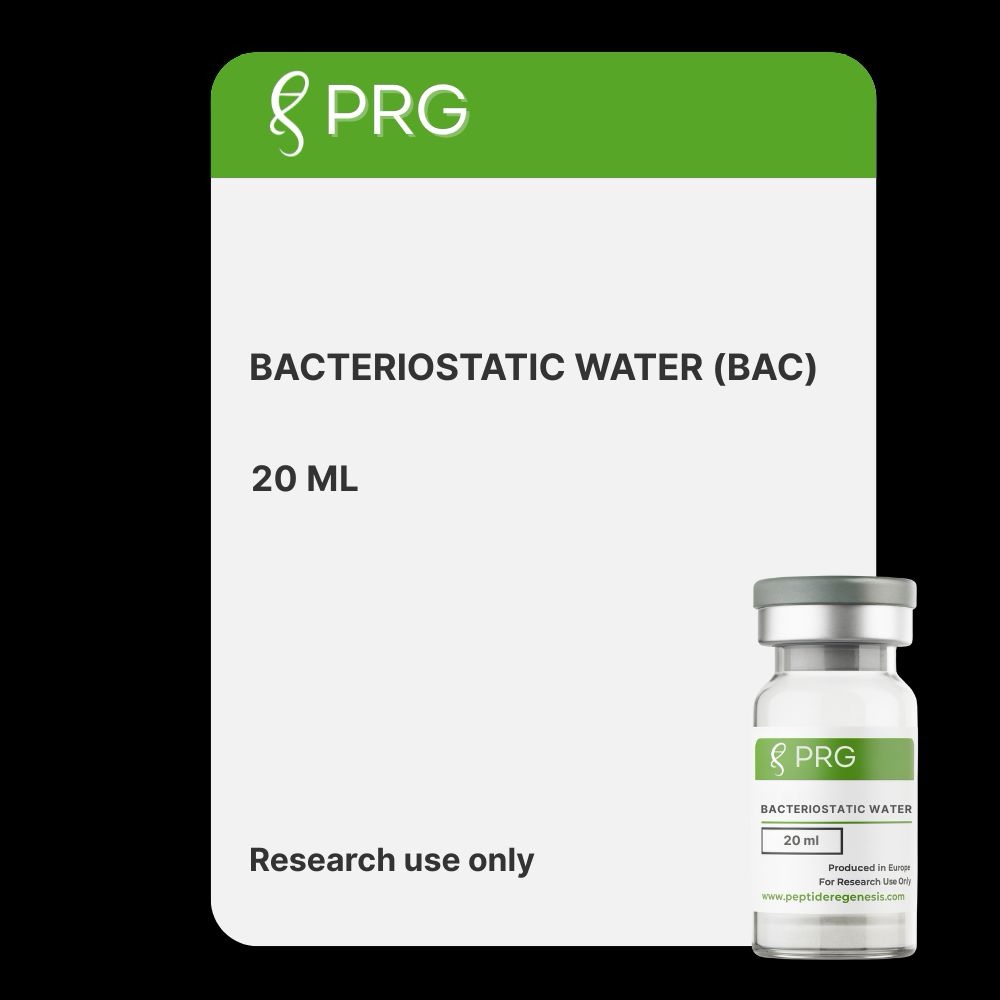
Bacteriostatic Water (BAC) for Laboratory Reconstitution Workflows
Bacteriostatic Water (BAC) is a sterile, laboratory-grade water preparation containing 0.9% benzyl alcohol, a compound that helps inhibit bacterial proliferation inside multi-use vials. Because of this stabilizing effect, BAC is widely used across research laboratories that require reliable reconstitution fluids for peptides, small molecules, and various investigative agents.
Unlike single-use sterile water, bacteriostatic water maintains its integrity over multiple entries, allowing researchers to withdraw aliquots at different points in an experiment without compromising the remaining volume. This characteristic makes BAC particularly useful in studies where repeated dilution, reagent preparation, or multi-phase setup is necessary.
Role in Research Reconstitution and Solution Preparation
In controlled laboratory environments, BAC is frequently selected for:
reconstituting peptides and other lyophilized materials
preparing dilutions for experimental assays
supporting workflows that involve repeated vial access
maintaining sterility during multi-step experimental timelines
Its composition is designed to preserve solution stability, minimize contamination risk, and support reproducibility across multiple experimental runs. Because BAC contains no sodium or buffering components, it provides a neutral base that does not interfere with biochemical signaling pathways or analytical readouts.
Why Researchers Prefer Bacteriostatic Water
Laboratories working with peptide studies, molecular biology, or metabolic models often rely on BAC because it provides:
extended usability within a single vial, reducing waste
consistent sterility, even during multi-access workflows
compatibility with a broad range of research compounds
a clear, predictable solvent profile that integrates smoothly into established protocols
These properties help reduce preparation variability, a critical factor in studies where experimental accuracy depends on maintaining uniform solution conditions from one trial to the next.
Laboratory Handling and Application Context
As with all reconstitution materials intended for scientific investigation, bacteriostatic water should be handled according to standard laboratory aseptic techniques. Researchers typically incorporate BAC into workflows involving lyophilized peptides, reference standards, or small-molecule models, ensuring precise concentration control during experimental planning.
BAC’s predictable performance and multi-use stability have made it a staple reagent across peptide facilities, molecular research teams, and biochemical laboratories seeking reliability in their preparation steps.
To support a wider range of laboratory workflows, researchers can also explore additional reconstitution materials such as PBS and HBS, along with other ready-to-use solutions available in our Liquid Formulas Collection.
Learn how bacteriostatic water compares to PBS and HBS in peptide preparation
Be the first to review “Bacteriostatic Water – 20 ml”
Related products
Weight Loss
Weight Loss
Weight Loss
Weight Loss

Reviews
There are no reviews yet.